Verifying a New Rig in One Shift: The 12-Hour Credit Check
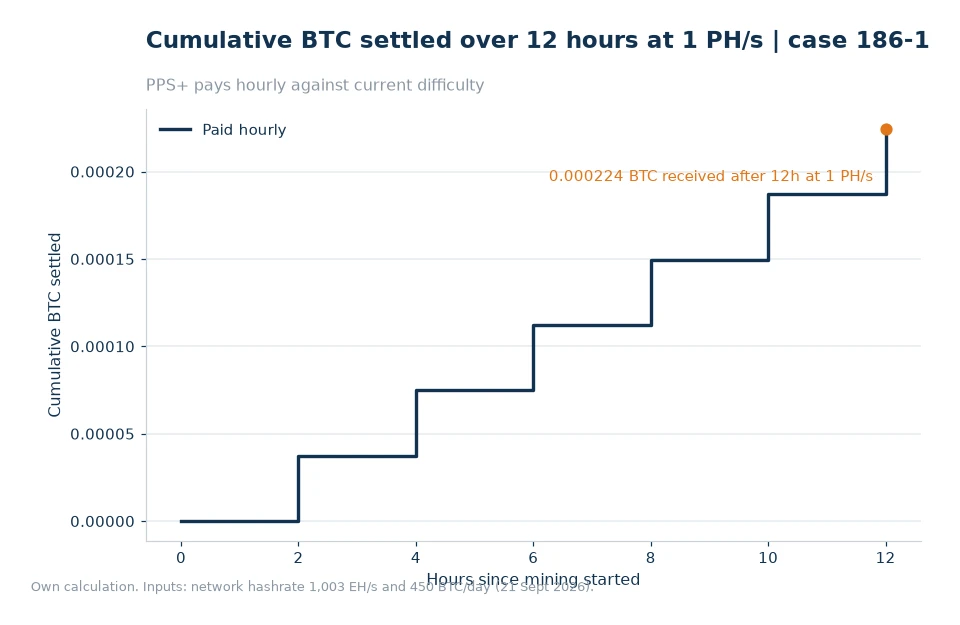
A freshly configured miner gives you almost nothing to judge in its first hour. A full working shift is different: at 1 PH/s the hourly step is 0.00001869 BTC, so 12 hours produce 0.0002243 BTC, worth $19.00 at $84,692 per BTC. That is enough to separate a working setup from a broken one before the rest of the rack follows it into the pool.

Key takeaways
- Twelve hours at 1 PH/s credits 0.0002243 BTC, or $19.00 at the read-date price.
- A wrong worker name produces a healthy dashboard and a zero credit history, which the shift check catches.
- Two hours of the shift are worth 0.00003738 BTC, so an early gap is visible without waiting for the total.
- One shift confirms the wiring, not the economics; cost per coin needs weeks of power data.
Why a shift is the right length for a first look
Twelve hours covers a full settlement cycle many times over and still fits inside the attention of the person who installed the machine. That combination is rare. Shorter checks catch almost nothing, because a single hour can be quiet for reasons that have nothing to do with your rig, and longer checks tempt you to keep a bad configuration running because you have already invested the wait.
Pick a shift you will actually be awake for at both ends. The point is to compare the pool's credit history with the machine's own log at two moments: just after the first share is accepted, and at the end of the window. If the two agree at both ends, the plumbing is correct and the remaining questions are commercial rather than technical.
What a bench test cannot tell you
A bench test proves that a power supply delivers voltage, that fans turn, and that the control board boots. It says nothing about whether the machine is submitting shares under the worker name you think it is, or whether those shares are being credited to the address you intend to be paid at. Those are account-level facts, and they only become visible after a settlement.
The failure mode is quiet. A miner pointed at a pool with a typo in the worker field will hash at full rate, show a normal temperature curve, and produce nothing in the credit history. Nothing overheats and nothing alarms. Twelve hours of expected credits that never appear is the cheapest way to find that mistake, provided you know what twelve hours should have produced.
Two other faults hide in the same window. A machine that is hashing but submitting stale work will show credits that lag its local share count. A machine on a firmware build that ignores the pool's difficulty setting may submit far fewer shares than its hashrate implies. Both look fine on a local screen and both show up as a short credit total.
Four settlement points in half a day
A checkpoint table beats a single endpoint because it shows the shape of the run. If the first two hours are correct and the last ten are not, the problem started after the machine was left alone, which is a different diagnosis from a rig that never credited at all.
| Elapsed | BTC credited | Value | Rate per hour |
|---|---|---|---|
| 2 hours | 0.00003738 | $3.17 | 0.00001869 BTC |
| 4 hours | 0.00007477 | $6.33 | 0.00001869 BTC |
| 8 hours | 0.00014954 | $12.66 | 0.00001869 BTC |
| 12 hours | 0.00022430 | $19.00 | 0.00001869 BTC |
The last column is the one to memorise. Once you know your own hourly step, any future window can be checked by multiplying, and you stop needing a table at all. A gap in the middle rows is also easier to place in time than a short final total, because the interval that failed is printed beside it.
Keep the table with the machine's serial number. When the same unit is reinstalled six months later, the old row gives you a reference for what a clean shift looked like on that exact hardware.
Read Pool Hashrate before you blame the machine
When a credit comes in lower than expected, the instinct is to inspect the rig. Most of the time the rig is fine and the denominator moved. Pool Hashrate and the network total both sit on the same summary screen, and either one growing shrinks your slice of each settlement without touching your hardware.
This is the reason a shift check should record three numbers rather than one: your hashrate, the pool's hashrate and the credit. Two of them explain the third. A technician who writes all three down once can tell a hardware fault from a market shift in about ten seconds, and that skill is worth more than any single dashboard widget.
The ViaBTC Mining Statistics page carries the pool and network figures next to the difficulty, which is the context a credit total needs. For the hardware side, the Miner Profitability Ranking shows where a given model sits at the current price and difficulty, so an unexpected shortfall can be checked against the model's expected output before anyone reaches for a screwdriver.
Why one credit is not yet a trend
A single settlement is a data point, not a pattern. PPS+ credits hourly against current difficulty, which makes the steps regular, but regular steps still sit inside a window whose total depends on the hashrate you actually delivered. A firmware update that reboots the machine twice will show as a smaller total without any pool-side fault at all.
Miners arriving from a PPLNS arrangement need more patience than this check allows. PPLNS pays after six confirmations and shares the miner's slice across the last five difficulty rounds, so the first credit can lag the first share by hours. A 12-hour window is still useful there, but read it as "has anything arrived" rather than "is the rate correct". The rate question belongs to the second or third day.
Worked example: half a day at one petahash
The arithmetic is short enough to do on paper at the bench, which is the point of doing it there.
- The chain issues 144 blocks a day at 3.125 BTC each, so 450 BTC is the daily total to divide.
- Divide by the network hashrate in terahashes, 1,003 million of them, and each terahash is credited 0.00000044865 BTC per day.
- A thousand terahashes make a petahash, so the daily figure rises to 0.00044861 BTC.
- Cut that into 24 settlement periods and one hour carries 0.00001869 BTC.
- Two hours of the shift therefore hold 2 × 0.00001869 = 0.00003738 BTC, worth $3.17.
- Twelve hours hold twelve such steps, 0.00022428 BTC, rounding to the 0.0002243 BTC in the chart.
- At $84,692 the endpoint is $19.00.
- Before the listed 4%, the same window was 0.0002243 ÷ 0.96 = 0.00023365 BTC, so the deduction cost about $0.79.
Frequently asked questions
How soon after switching pools should the first credit appear?
On PPS+ the first credit normally lands within the first hourly settlement, so a 12-hour window should show 12 steps totalling 0.0002243 BTC at 1 PH/s; a PPLNS switch can take longer because it waits for six confirmations.
Can I run this check with a single machine instead of a petahash?
Yes, but scale the target: one 200 TH/s unit earns a fifth of the figures here, about 0.00004486 BTC in 12 hours, which is still large enough to distinguish a working account from a silent one.
What if the rig hashes correctly but credits arrive late?
Late credits usually mean the wrong payment scheme for your expectations rather than a fault; PPS+ settles hourly while PPLNS waits for confirmations and a five-round window, so match the check to the scheme you selected.
Write the shift note, then widen the window
Record four lines before you leave the room: start time, hashrate, expected 12-hour credit and the actual credit. If they match, add the next machine. If they do not, you have lost 12 hours instead of a week, and the note tells you which of the three numbers moved. Keep the same habit when the rack is full and the window stretches from a shift to a season.
Data basis: BTC $84,692, difficulty 132.76 T and 1,003 EH/s, all read on 21 Sept 2026, plus 144 daily blocks paying 3.125 BTC each. Listed rates are from the pricing page[1]. The shift arithmetic assumes twelve unbroken hours. Posted 24 Oct 2026.