Setting Boundaries in AI Companion Chat
Boundaries are what turn a novelty into something you can keep doing without regrets, and they are cheaper to set before a session than after one. Crushon builds its companion experience around characters that adapt to your personality and remember your preferences, which means the limits you state early are limits the character carries forward. That continuity is the whole argument: a rule you set once does the work of a rule you would otherwise restate every night.

Key takeaways
- State your limits in the first session, because remembered preferences carry them into later chats.
- Fix three boundaries before you start: a time budget, a topic list, and a rule about what you will not do to keep momentum.
- Judge a limit by whether it survives a boring evening, not by whether it sounds reasonable on a good one.
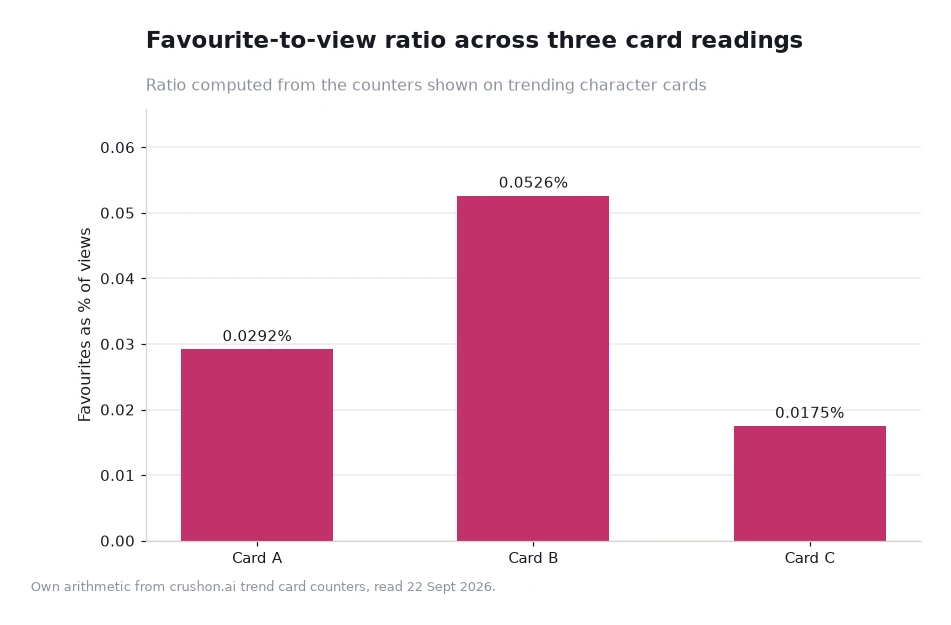
- Favourites among trending cards sit between 0.0175% and 0.0526% of views, which is a reminder that popular characters are not automatically the right ones for you.
Why self-imposed limits improve the experience
A conversational system responds to whatever you give it, which cuts two ways. Give it a clear frame and the replies stay inside that frame; give it drift and the conversation follows the drift. Boundaries are therefore not a restriction on the platform, they are an input to it. A character told at the outset that you want a slow, character-driven roleplay will behave differently from one given no direction at all.
The second reason is habit. Adult chat is easy to extend, because there is no natural stopping point at the end of an episode, no credits, no closing time. Without a boundary, the session ends when you run out of energy rather than when you decided to stop, and that is the pattern people regret. A boundary turns the decision into something you made in advance instead of something fatigue makes for you.
The third reason is that limits make preference visible. Once you know what you will not do, the characters that fit you become easier to identify through tags and descriptions, and you spend less time sampling. Readers who search for sex ai experiences usually arrive with an appetite and no plan; the plan is what makes the second week better than the first.
Three boundaries worth writing down
The first is time. Pick a session length and a weekly ceiling and treat them as the budget rather than the aspiration. The second is topic: decide which subjects you want to explore and which you would rather leave alone, because a system that adapts to your preferences will happily follow you somewhere you did not intend to go. The third is momentum: decide in advance what you will do when a conversation goes quiet, so that the answer is not always "keep typing".
| Boundary | Concrete version | Failure it prevents |
|---|---|---|
| Time | A session length and a weekly ceiling, written before the session starts | Sessions that end from exhaustion instead of a decision |
| Topic | A short list of subjects you want, and a shorter list you do not | Drifting somewhere you did not choose, because the character follows your lead |
| Momentum | A closing line you use instead of typing past a lull | Dead conversations that continue out of inertia |
| Characters | A shortlist drawn from tags and descriptions rather than raw popularity | Endless sampling, and time spent on characters that never fit |
| Review | A weekly glance at how the week actually went against the budget | Quiet drift, where good intentions are never checked |
The fourth row is the one people underrate. Popularity data on a trend page is a description of the crowd, and the crowd is not you. Two cards sitting at 0.0175% and 0.0526% of views differ by a factor of three in how often viewers save them, and the higher ratio still tells you nothing about whether the character's tone matches the limit you set for yourself.
Worked example: a boundary that survives the month
Take the volume question and turn it into a boundary rather than an outcome. Assume a 30-day month and no missed days, and decide the ceiling in advance. At 6 messages a day the month contains 6 × 30 = 180 messages. At 25 a day it contains 750. At 80 a day it contains 2,400, which is more than a message every waking twenty minutes if they are spread across a typical day.
Now apply the boundary logic to each level. If your stated ceiling is 25 messages a day, the 750-message month is your plan rather than your accident, and the only thing left to check is whether you stayed under it. If you find that a week actually ran at 80 a day, the useful conclusion is not guilt, it is information: either the boundary was set too low and should be raised honestly, or the session habit needs one structural change, such as a fixed end time.
The numbers above come from the author's own arithmetic on an illustrative usage profile, not from the platform, and a 30-day month with no missed days is a simplifying assumption. The measurement matters more than the figure: a boundary you never check is a preference, and a preference drifts.
How continuity changes the rules
Remembered preferences are what make an early boundary efficient, and also what make an unexamined boundary sticky. A rule stated in month one can keep shaping conversations in month three, which is excellent when the rule still fits and awkward when it does not. The fix is a periodic reset: every few weeks, restate what you want in plain language, so the frame reflects the version of you that is actually chatting.
That is also why the character shortlist deserves a second look. A card that read as perfect at the start can turn out to be a poor fit once your own boundaries are clearer. Rebuilding the shortlist is a two-minute job that pays for itself, and the trend list is only one place to start from: the character search page lets you work from tags instead of from whatever happens to be ranked.
Reviewing limits without turning them into rules
A boundary review should take five minutes a week and produce exactly one change, or none. Ask three questions: did the week stay inside the time budget, did the conversations stay inside the topic frame, and did any session end by decision rather than by fatigue? A single "no" is a signal; three "no"s in a row mean the boundary itself was mispriced.
The distinction between a limit and a rule matters. Limits describe what you want from the platform, and they are yours to move. Rules describe what the platform permits, and those are set by the operator: unfiltered describes a catalogue slice, while the platform's content and community guidelines still apply, and some limitations follow from them. Keeping the two categories apart stops a personal boundary from feeling like a policy grievance, and stops a policy from being mistaken for a personal choice.
The full picture of how the companion experience is framed, including the wording about adapting to your personality and remembering your preferences, sits on the platform's own pages rather than in a summary like this one.
Frequently asked questions
Will a character remember a boundary I mention early on?
That is the design intent: characters adapt to your personality and retain preferences from earlier interactions. If a limit seems to have been dropped after a while, restate it plainly rather than assuming it was overridden.
Is setting limits a sign that I am using the platform badly?
No, it is the opposite. Limits convert an open-ended activity into a repeatable one, which is why the same technique works for streaming, games and anything else with no built-in stopping point.
How do I choose between two characters when both look suitable?
Use description first and popularity second. Read what the creator wrote, check the tags for framing, then use the counters only to break a genuine tie.
What if my boundary turns out to be too strict?
Then move it, deliberately. A limit revised once after a review is a working boundary; a limit quietly ignored every week is a signal that the budget needs rethinking.
Write the limits before the first message
Before your next session, write down three lines: how long, what subjects, and how it ends. State them in the chat so they carry forward, then check once a week whether they held.
That is the entire practice. It takes less time than choosing a character, and it is the difference between a habit you keep and one you quit.
Data and sources: favourite and view counters shown on the trending character cards, the framing of Sex AI companions, and the platform's content and community guidelines as published, all read 22 Sept 2026[1]. Message volumes are illustrative arithmetic by the author. Suitable for readers who are 18 or older.