A factory inspection can miss important risks when the scope is vague, the wrong site is reviewed, observations are disconnected from production records, or corrective actions are closed without verification. Define the decision, criteria, site, evidence, and authority in advance; then record limitations and tie findings to the buyer’s supplier and shipment controls.
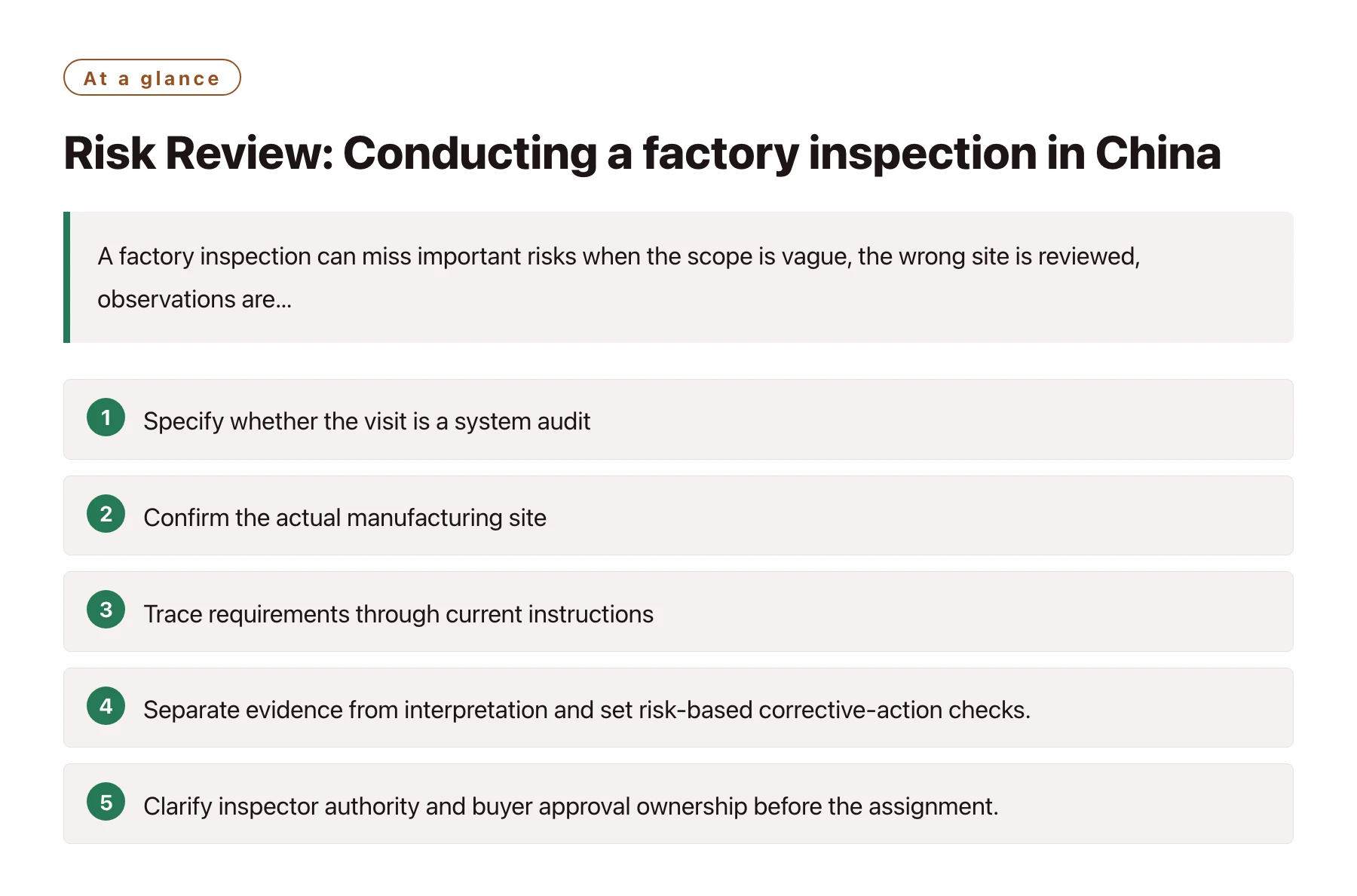
Key takeawaysSpecify whether the visit is a system audit, process review, or product inspection. · Confirm the actual manufacturing site, line, product, shift, and subcontractors. · Trace requirements through current instructions, observed work, and lot records. · Separate evidence from interpretation and set risk-based corrective-action checks. · Clarify inspector authority and buyer approval ownership before the assignment.
A risk review of factory inspection asks whether the visit can support the decision the buyer needs. The process should state what was assessed, how evidence was gathered, what remains uncertain, and who decides next steps.
Risk before the visit: the inspection question is too broad
A request to inspect a factory can mean a management-system audit, a production-capability review, an in-process observation, a product inspection, or a general tour. Each has a different scope and requires different competence and evidence. Agree the question the visit must answer and what decision depends on it before booking travel or remote access.
Write the audit criteria in observable terms: the approved product and revision, process steps, records, acceptance limits, and relevant supplier commitments. Identify what is outside scope, such as legal compliance opinions, engineering validation, or laboratory testing. If those decisions matter, assign a qualified specialist and arrange the required evidence separately.
ISO 19011:2026 provides guidance on auditing management systems, including audit principles, audit program management, conducting audits, and auditor competence.[1] It is not a certification or a substitute for product inspection. Select an approach and auditor capability that fit the actual review objective.
Risk during preparation: the wrong site or process is assessed
Confirm the legal entity, physical address, production line, product, shift, and subcontractors involved in the order. Suppliers may have sales offices, group companies, trading partners, or multiple factories. Put the specific site and process in the visit plan and ask who will be present to answer technical and quality questions.
Request documents in advance: process flow, organization roles, current work instructions, product specification, inspection plan, sample records, calibration status where relevant, traceability, and open corrective actions. Ask for a current revision and state how sensitive records will be protected. Early review allows the visit to focus on gaps rather than searching through unrelated files.
Check readiness and access constraints. Confirm production schedule, safety induction, language support, permitted photographs, personal protective equipment, and whether the relevant process will run. If a key area is unavailable, plan an alternative evidence review and a clear limit on the conclusion.
Risk in the factory: observations are disconnected from records
Follow a product or lot from incoming material to final release. Ask staff to show the current requirement at the point of work, the corresponding inspection method, and a record from an actual production run. Compare the product identity, revision, results, operator or equipment reference, and approval status across those records.
Observe a process step and ask what happens when a result is out of range. Look for identification and segregation of suspect output, escalation, disposition, and evidence that corrective actions reach the next lot. The visit should record what was actually seen and whether the response matched the supplier’s controlled procedure.
Use interviews to clarify roles and practice, not as the only evidence. If an operator, supervisor, and quality contact describe different acceptance rules, record the inconsistency and determine which document is current. Keep observations factual and avoid inferring intent from demeanor or language differences.
Risk in findings: the report mixes facts and conclusions
For each issue, record the criterion, evidence, observed gap, affected item or process, and significance to the purchase. Distinguish a confirmed nonconformance from a concern or improvement suggestion. A precise description helps the supplier respond and lets the buyer judge severity without relying on a vague score.
Attach photographs or document references with enough context to identify the process and revision. Record unavailable evidence and access limits. If the visit relies on a sample, state how it was selected and what it can and cannot show. Do not imply that a few records represent every product line or every shift unless the plan supports that scope.
Ask the supplier to confirm factual details while preserving the review team’s own finding and evidence. Keep translations or summaries linked to the original record when technical meaning may be disputed. Protect confidential information through agreed access, retention, and redaction controls.
Risk after the visit: actions are closed without proof
Assign each finding an owner, due date, containment action, correction, cause analysis where appropriate, and closure evidence. Determine whether the issue blocks supplier approval, production start, or shipment release. The buyer’s quality owner should approve the classification and the risk accepted, if any.
Select a verification method that tests the correction at the right level. A revised document may close a document-control gap; a process issue may need a subsequent lot record, observation, or test. Keep the action open until evidence is reviewed, and record who accepted closure.
Link the visit report to the supplier register, purchase order, and any conditional approval. Set refresh triggers for site, process, ownership, or subcontractor changes and repeated quality failures. An inspection report should continue to inform future orders rather than remain isolated in an email attachment.
Risk in the service arrangement: authority is unclear
Before engaging an inspection coordinator, agree the scope, access, criteria, report format, response timeline, photography, travel, and confidentiality. State whether the inspector may only report findings or also hold loading, request correction, or recommend release. Final acceptance and concession authority should be named in the contract or internal procedure.
Ask how competence is matched to the product and task. A process audit may require management-system experience; measurement of a technical characteristic may require trained personnel and appropriate tools. Review sample reports and confirm how discrepancies are escalated. The buyer should know which parts are observed directly and which come from supplier statements.
For China factory visit and inspection coordination, checking a supplier facility in China is one option to assess against the project’s requirements. Confirm the actual scope and keep engineering, quality, and regulatory decisions with the assigned specialists.
Sources
Frequently asked questions
What should be decided before a factory inspection is booked?
Define the objective, criteria, site, product and process scope, required records, access, auditor competence, report format, and the decision that will rely on the results.
Can a factory inspection confirm legal compliance?
Only when that is explicitly within scope and performed by a qualified reviewer against applicable requirements. A routine factory visit should not be described as a legal compliance determination.
What is enough evidence to close a factory finding?
Use evidence matched to the gap and risk. A document issue may need an approved revision, while a process issue may need production records or a follow-up observation that confirms implementation.
Who may approve shipment after an inspection?
Name the buyer’s authorized quality or commercial decision owner. An inspector should report evidence and exercise only the authority assigned in writing.